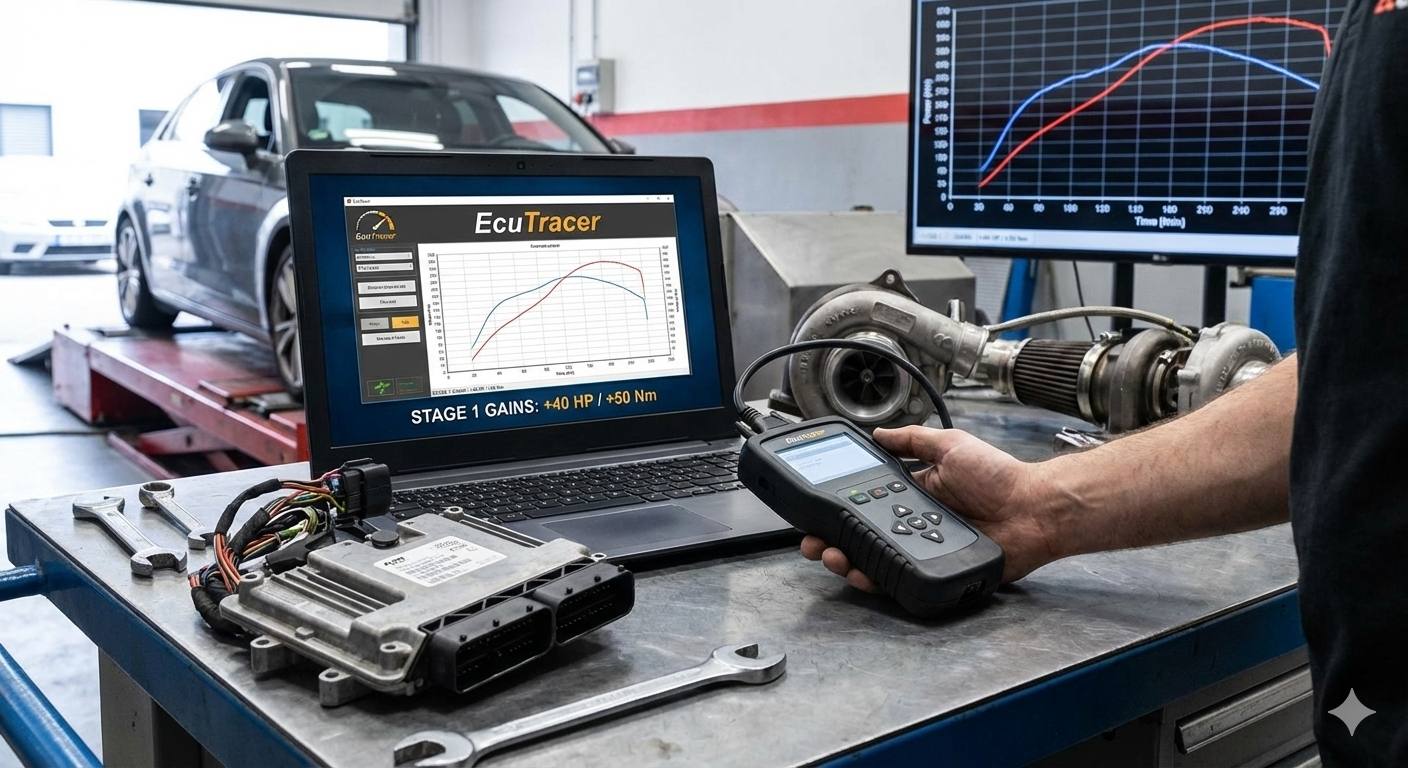
This is the most frequent question from any customer interested in chip tuning. And it makes sense: before investing in a remap, you want to know what results you'll get. Therefore, in this article, we explain exactly how many horsepower and Nm your car can gain.
Furthermore, we'll examine the factors that influence profits, identify the best-performing engines, and provide real-world examples by make and model. In short, we'll give you all the information you need to advise your clients with concrete data.
📊 Typical Earnings by Engine Type
Not all engines respond the same way to reprogramming. Therefore, the first step is to understand what to expect based on the type of engine.
🔵 Turbo Diesel Engines
Turbocharged diesel engines respond best to chip tuning. They also offer the greatest performance gains.
Typical gains in Stage 1:
- ✅ Power: +20% to +35%
- ✅ Torque: +25% to +40%
Why do they earn so much?
- 🔹 Manufacturers severely limit them as standard due to emissions regulations
- 🔹 The turbo has room to provide more pressure
- 🔹 Diesel injection responds very well to optimization
- 🔹 They often share the same engine as more powerful versions
Practical example: A Volkswagen Golf 2.0 TDI with 150 hp can easily reach 185-195 HP with a Stage 1. In addition, the torque goes from 340 Nm to 410-430 Nm.
🔴 Turbocharged Gasoline Engines
Turbocharged gasoline engines also perform very well. However, the percentage gains are usually somewhat lower than in diesel engines.
Typical gains in Stage 1:
- ✅ Power: +15% to +30%
- ✅ Torque: +20% to +35%
Why do they earn less than diesel?
- 🔹 They already come more optimized as standard.
- 🔹 The detonation limit is more restrictive
- 🔹 Fuel quality has a greater influence
Practical example: An Audi A3 2.0 TFSI with 190 hp can reach 230-250 HP with a Stage 1. Therefore, the jump is very noticeable in terms of feel.
⚪ Naturally aspirated engines (without turbo)
Naturally aspirated engines are the least efficient. However, they can also be optimized.
Typical earnings:
- ✅ Power: +5% to +10%
- ✅ Torque: +5% to +10%
Why do they earn so little?
- 🔹 They don't have a turbo to optimize
- 🔹 The default maps are already quite well adjusted
- 🔹 The margin for improvement is physically limited
Practical example: A 160 hp Mazda MX-5 2.0 can win 8-15 HP with a reprogramming. It also improves throttle response and power delivery.
📈 Profit Chart by Brand and Model
Below are real-world examples of performance gains on popular models. This data is based on dynamometer measurements.
🇩🇪 Volkswagen Group (VW, Audi, SEAT, Skoda)
| Model | Engine | CV Series | CV Stage 1 | Gain |
|---|---|---|---|---|
| VW Golf VII | 2.0 TDI | 150 HP | 190 hp | +40 HP |
| VW Golf VII | 1.4 TSI | 125 HP | 155 HP | +30 CV |
| VW Golf VII GTI | 2.0 TSI | 230 HP | 280 hp | +50 HP |
| Audi A4 B8 | 2.0 TDI | 143 hp | 180 HP | +37 CV |
| Audi A3 8V | 2.0 TDI | 150 HP | 195 hp | +45 HP |
| Audi A3 8V | 2.0 TFSI | 190 hp | 245 hp | +55 HP |
| SEAT Leon 5F | 2.0 TDI | 150 HP | 190 hp | +40 HP |
| SEAT Leon Cupra | 2.0 TSI | 290 hp | 350 HP | +60 HP |
| Skoda Octavia III | 2.0 TDI | 150 HP | 190 hp | +40 HP |
🇩🇪 BMW
| Model | Engine | CV Series | CV Stage 1 | Gain |
|---|---|---|---|---|
| BMW 320d F30 | 2.0d | 163 hp | 205 hp | +42 CV |
| BMW 520d F10 | 2.0d | 184 hp | 225 hp | +41 CV |
| BMW 330d F30 | 3.0d | 258 hp | 310 hp | +52 CV |
| BMW 120i F20 | 2.0i | 177 hp | 210 hp | +33 CV |
| BMW M135i F20 | 3.0i | 320 HP | 380 hp | +60 HP |
| BMW M2 F87 | 3.0i | 370 hp | 420 HP | +50 HP |
🇩🇪 Mercedes-Benz
| Model | Engine | CV Series | CV Stage 1 | Gain |
|---|---|---|---|---|
| Class C 220d W205 | 2.0d | 170 hp | 210 hp | +40 HP |
| E-Class 220d W213 | 2.0d | 194 hp | 235 hp | +41 CV |
| Class A 200d W177 | 2.0d | 150 HP | 190 hp | +40 HP |
| A-Class A35 AMG | 2.0i | 306 hp | 365 hp | +59 CV |
| C-Class 43 AMG | 3.0i V6 | 390 hp | 450 HP | +60 HP |
🇫🇷 PSA Group (Peugeot, Citroën)
| Model | Engine | CV Series | CV Stage 1 | Gain |
|---|---|---|---|---|
| Peugeot 308 | 1.6 BlueHDi | 120 HP | 155 HP | +35 HP |
| Peugeot 3008 | 2.0 BlueHDi | 150 HP | 190 hp | +40 HP |
| Peugeot 208 GTi | 1.6 THP | 208 hp | 250 HP | +42 CV |
| Citroën C4 | 1.6 BlueHDi | 120 HP | 155 HP | +35 HP |
| DS4 | 2.0 BlueHDi | 180 HP | 215 hp | +35 HP |
🇺🇸 Ford
| Model | Engine | CV Series | CV Stage 1 | Gain |
|---|---|---|---|---|
| Ford Focus | 1.5 TDCi | 120 HP | 155 HP | +35 HP |
| Ford Focus | 2.0 TDCi | 150 HP | 185 hp | +35 HP |
| Ford Focus ST | 2.0 EcoBoost | 250 HP | 300 HP | +50 HP |
| Ford Focus RS | 2.3 EcoBoost | 350 HP | 400 HP | +50 HP |
| Ford Fiesta ST | 1.5 EcoBoost | 200 HP | 235 hp | +35 HP |
🇪🇸 SEAT (additional models)
| Model | Engine | CV Series | CV Stage 1 | Gain |
|---|---|---|---|---|
| SEAT Ibiza | 1.6 TDI | 95 HP | 125 HP | +30 CV |
| SEAT Ibiza FR | 1.5 TSI | 150 HP | 180 HP | +30 CV |
| SEAT Ateca | 2.0 TDI | 150 HP | 190 hp | +40 HP |
| SEAT Tarraco | 2.0 TDI | 190 hp | 230 HP | +40 HP |
🔍 What Factors Influence Profit?
Not all cars of the same model earn exactly the same amount. Therefore, several factors influence the final result.
1️⃣ Engine status
An engine in good condition benefits more from reprogramming:
- ✅ Clean and calibrated injectors
- ✅ Turbo in good condition
- ✅ Clean air filter
- ✅ Oil in good condition
- ✅ No pressure leaks
Conversely, an engine with mechanical problems will not achieve the expected performance. Furthermore, it could exacerbate existing problems.
2️⃣ Fuel quality
Especially important in turbocharged gasoline engines:
- 🔹 95 Octane Gasoline: It allows for moderate profits
- 🔹 98 Octane Gasoline: It allows you to get more out of the reprogramming
- 🔹 Standard diesel: It works well in most cases
- 🔹 Premium diesel: Minor additional improvement
Therefore, we recommend using quality fuel after a reprogramming.
3️⃣ Altitude and ambient temperature
Environmental conditions affect performance:
- 🔹 At higher altitudes, there is less oxygen and less power.
- 🔹 At high temperatures, the air is less dense
- 🔹 Bench measurements are taken at sea level and 20-25°C
Therefore, the gain values are references under optimal conditions.
4️⃣ Vehicle mileage
Natural wear and tear affects engine potential:
- ✅ 0-100,000 km: Maximum profit potential
- ⚠️ 100,000-200,000 km: Normal earnings
- ⚠️ +200,000 km: Check status before reprogramming
However, a well-maintained engine can be successfully reprogrammed regardless of mileage.
5️⃣ Original software version
Some vehicles have different factory software versions:
- 🔹 Software from one country may be more restrictive than another
- 🔹 Manufacturer updates may limit power
- 🔹 "Eco" versions have more room for improvement
Therefore, the original file influences the final result.
💡 Why Do Manufacturers Limit Power?
This is a very common question: if the engine can do more, why doesn't it come like that as standard?
Main reasons:
1. Emissions regulations
- Manufacturers must comply with very strict CO2 limits
- More power usually means more emissions
- Therefore, they limit performance to pass homologation tests.
2. Range scaling
- The same engine is used in different versions (150 hp, 190 hp, 240 hp)
- It is limited by software to create different models
- Consequently, the cheaper versions have room for improvement.
3. Safety margin
- Manufacturers design with the worst-case scenario in mind.
- Low-quality fuels in some countries
- Poor maintenance
- Extreme conditions of use
4. Commercial strategy
- Selling the same engine in different power versions
- Offering official "power packs" at a high price
- Therefore, the margin exists, but they charge it as an extra.
🧮 Use Our Power Calculator
Want to know exactly how much your vehicle can earn? At EcuTracer we have a power calculator where you can check the specific earnings for your make, model and engine.
How it works:
- ✅ Select your vehicle brand
- ✅ Choose the model
- ✅ Select the engine and year
- ✅ Check the estimated earnings
👉 Check your vehicle in our calculator
The calculator's data is based on actual dynamometer measurements. Furthermore, it is constantly updated with new models.
📈 Stage 1 vs Stage 2 vs Stage 3 Earnings
If you want to go beyond Stage 1, the earnings increase. However, the requirements also increase.
| Stage | Requirements | Additional gain vs series |
|---|---|---|
| Stage 1 | None | +20% to +35% |
| Stage 2 | Downpipe, admission | +35% to +50% |
| Stage 3 | Turbo, injectors, internals | +50% to +100%+ |
Example in a Golf GTI 2.0 TSI 230 HP:
- Stage 1: 280 hp (+50 HP)
- Stage 2: 320 HP (+90 HP)
- Stage 3: 400+ HP (+170 HP)
📖 Related: Stage 1, Stage 2 and Stage 3 Guide: Differences and Which One to Choose
⚡ Beyond CVs: Other Benefits
Reprogramming doesn't just increase power. It also improves other aspects of the vehicle:
✅ Improved accelerator response
The car responds more quickly when you press the accelerator. As a result, driving is more agile and enjoyable.
✅ Torque across the entire rev range
It's not just more power at higher revs. Torque increases across the entire rev range, especially at low and mid-range RPMs.
✅ Safer overtaking
With more power available, overtaking maneuvers are shorter and safer. Therefore, you reduce the time spent in the oncoming lane.
✅ Less engine effort
With more power available, the engine operates more smoothly under normal use. Furthermore, you don't need to rev it as high to get the same response.
✅ Possible reduction in consumption
Many customers report the same or lower fuel consumption after the reprogramming. The engine runs more efficiently and you need less throttle.
❓ Frequently Asked Questions about Power Gains
🔹 Are the profits you indicate guaranteed?
The values are estimates based on actual measurements. However, every vehicle is different and the result may vary by 5-10% above or below depending on the engine's condition.
🔹 How can I check the actual power output after reprogramming?
The most reliable way is to measure on a dyno. This will also give you accurate power and torque data at each engine speed.
🔹 Can my 100 hp car reach 200 hp?
It depends on the engine. A naturally aspirated 100 hp engine won't reach 200 hp. However, a 1.0 TSI turbo with 100 hp can approach 130-140 hp. Therefore, the turbocharger is key.
🔹 Is it safe to increase the power that much?
Yes, provided the reprogramming is done professionally. Manufacturers allow sufficient safety margins. Furthermore, at EcuTracer we test all calibrations before delivery.
🔹 Does it affect fuel consumption?
Under normal use, fuel consumption usually remains the same or decreases slightly. However, if you constantly floor the accelerator to take advantage of the new power, you will consume more fuel.
🔹 How much does reprogramming cost depending on the CVs you want to earn?
The price doesn't depend on the horsepower you gain, but on the vehicle. A Stage 1 tune has a fixed price regardless of whether you gain 30 hp or 60 hp.
🔹 Does my insurance cover the reprogrammed car?
Technically, changes should be reported to the insurer. In practice, most don't. However, we recommend checking the terms and conditions of each policy.
✅ Conclusion
The power gain from a remap depends primarily on the engine type. In summary:
- 🔵 Turbo diesel: +20% to +35% (the most grateful)
- 🔴 Turbo gasoline: +15% to +30% (very good results)
- ⚪ Atmospheric: +5% to +10% (limited improvement)
The factors that influence performance are: engine condition, fuel quality, mileage, and original software version. Therefore, a well-maintained vehicle will achieve the best results.
Want to know exactly how much your vehicle can gain? Use our horsepower calculator or contact us for personalized advice.
🔥 Ready to feel the difference? Request your file from EcuTracer and you'll have it in less than 1 hour.