
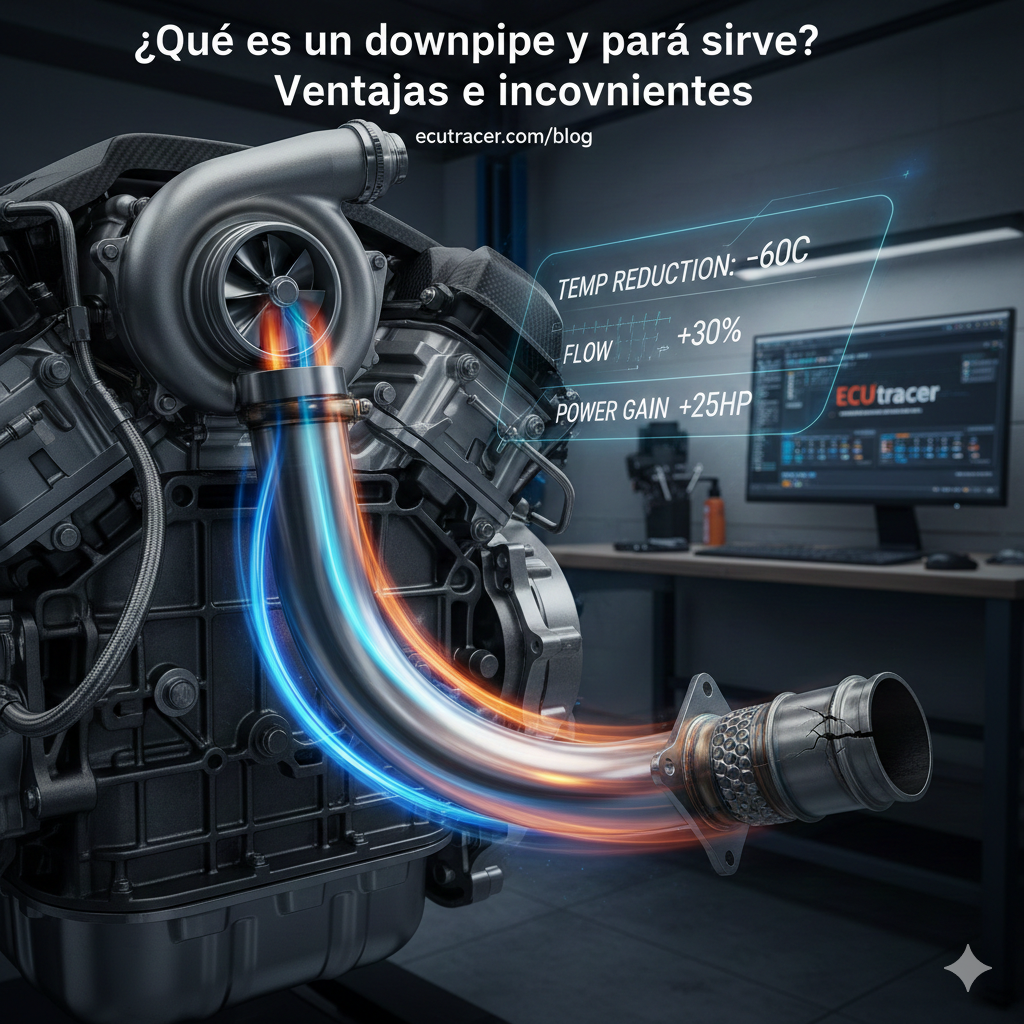
A downpipe is the section of the exhaust that runs from the turbo outlet to the mid-pipe and, on standard cars, usually houses the main catalytic converter. Replacing it with a larger-diameter one reduces back pressure and exhaust gas temperature, and it is one of the most common modifications in Stage 2 builds. If the catalytic converter is removed or replaced with a high-flow sports cat, the ECU has to be remapped so that the lambda sensors and catalyst diagnostics do not trigger faults.
In this article we explain what a downpipe is, how it works, what advantages it offers and what aspects you should consider to choose the most suitable one for your car.
⚙️ What is a downpipe?
In a turbocharged engine, the exhaust system is divided into several sections. The downpipe is the initial section of the exhaust, located right at the turbocharger outlet, and is responsible for channeling the exhaust gases to the rest of the system (midpipe and rear muffler).
Because it is located in a critical area, the downpipe directly influences the exhaust backpressure, the temperature of the gases, and the efficiency of the turbo itself.
In most production vehicles, the downpipe incorporates a catalytic converter, whose purpose is to reduce polluting emissions before the gases are released into the environment.
🌡️ Function of the catalyst in the downpipe
The catalytic converter is a mandatory component in road vehicles. Its function is to transform the harmful gases generated by combustion into less polluting compounds.
The catalysts of origin are usually:
- 🔹 Of ceramic structure
- 🔹 With high cell density (400–600 cells)
This ensures compliance with anti-pollution regulations, but considerably limits the flow of gases.
This restriction causes:
- 🔹 Greater counterpressure
- 🔹 Increased exhaust temperature
- 🔹 Lower turbo efficiency
🏎️ Why does a downpipe improve performance?
Installing a performance downpipe significantly improves exhaust flow. This not only allows for the evacuation of a greater volume of exhaust gases but also reduces heat buildup in the turbocharger and manifold.
A lower exhaust temperature translates to:
- 🔹 Improved cylinder filling
- 🔹 Greater thermal stability
- 🔹 Possibility of working with more efficient engine maps
✅ Main benefits of a sports downpipe
- 🔹 Improved gas flow
- 🔹 Reduction of exhaust temperature
- 🔹 Increased power and torque
- 🔹 Improved turbo response
- 🔹 Sportier sound
🔩 Types of downpipe
catalyzed downpipe
It incorporates a catalytic converter, although not all of them comply with regulations. This is where it's important to pay special attention.
Metallic vs. ceramic catalysts
High-performance downpipes typically use metallic catalysts, which offer clear advantages over ceramic ones:
- 🔹 Better thermal conductivity
- 🔹 Faster warm-up
- 🔹 Reduced substrate thickness
- 🔹 Greater mechanical resistance
- 🔹 Improved gas flow at the same efficiency
In balanced preparations, 200-cell metal catalysts are the best option because:
- 🔹 They maintain a good level of emissions
- 🔹 They offer a much higher flow than the standard one.
- 🔹 They significantly reduce the exhaust temperature
There are very inexpensive downpipes with 100-cell catalytic converters, but they usually comply with old regulations and are not recommended for legal road use.
decatalyzed downpipe
The decatalytic downpipe completely eliminates the catalytic converter. It is a solution designed exclusively for racing or track use.
Main features:
- 🔹 Maximum gas flow
- 🔹 Very high thermal reduction
- 🔹 Greater sound
- ❌ Does not comply with emissions regulations
- ❌ Not valid for MOT
Although its performance is excellent, it requires replacement before passing inspection, so its use should be carefully considered.
📏 Importance of downpipe diameter
The diameter must be appropriate:
- 🔹 To the engine displacement
- 🔹 At the level of preparation
- 🔹 To the use of the vehicle
A common mistake is installing a large-diameter downpipe while keeping the rest of the exhaust system stock. This creates a bottleneck that negates some of the improvements gained.
👉 For optimal results, the entire exhaust system must be balanced, from the turbo to the final outlet.
💻 Is it necessary to reprogram the ECU when installing a downpipe?
In most cases, it is recommended.
Modern vehicles monitor the efficiency of the catalytic converter using sensors. Modifying the downpipe can cause the common P0420 fault code to appear, even if the car is running correctly.
Furthermore, by reducing the exhaust temperature (in some cases to 60–70 °C), the door is opened to:
- 🔹 Improve engine load
- 🔹 Optimize turbo boost
- 🔹 Adjust security parameters
Therefore, a well-calibrated Stage 2 reprogramming allows you to reliably take full advantage of the modification's potential.
When would rescheduling not be essential?
If a high-quality, approved catalytic downpipe is installed, it is possible that:
- 🔹 No errors appear
- 🔹 The car works correctly without adjustments
Even so, maximum performance is only achieved by optimizing the ECU.
🎯 How to choose the right downpipe?
Not all downpipes are the same. To get it right, the following is essential:
- 🔹 Define the objective of the preparation
- 🔹 Consider the use of the vehicle
- 🔹 Ensure compatibility with the rest of the exhaust system
- 🔹 Get professional advice
An incorrect choice can lead to reliability problems, electronic errors, or lower than expected performance.
❓ Frequently asked questions about downpipes
🔹 What is a downpipe on a car?
The downpipe is the first section of the exhaust system, located right after the turbocharger. It channels the exhaust gases to the rest of the system and has a direct impact on the performance of the turbocharged engine.
🔹 What is the downpipe used for?
It efficiently evacuates exhaust gases from the turbocharger. A performance downpipe improves gas flow, reduces exhaust temperature, and allows for increased power and improved turbo response.
🔹 What is a high-flow downpipe?
It's a performance downpipe designed to maximize exhaust flow. It can be catalyzed (with a 200-cell metallic catalyst) or decatalyzed. It offers less restriction than the stock downpipe and improves performance.
🔹 Is the downpipe very noticeable?
Yes, especially when combined with a Stage 2 remap. The most noticeable improvements are: better turbo response, increased power, a sportier sound, and reduced exhaust temperatures (up to 60-70°C less).
🔹 Is it legal to install a downpipe?
It depends on the type. A catalysed downpipe can be used on the road and pass the MOT if it is type-approved for that specific vehicle. Decat versions are only valid for track or competition use, as they do not meet emissions regulations.
🔹 Do you have to reprogram the ECU when installing a downpipe?
It's highly recommended. By changing the exhaust flow, the ECU can detect errors like P0420. Furthermore, a Stage 2 remap allows you to safely and reliably harness the full potential of the modification.
🔹 Which downpipe is better, catalyzed or decatalyzed?
For road use, the catalyzed version with a 200-cell metallic catalyst is the best option: it offers excellent flow, meets regulations, and doesn't generate errors. The decatalyzed version offers maximum performance but is only suitable for track use.
🔹 What downpipe diameter do I need?
It depends on the engine displacement, target power output, and the rest of the exhaust system. The important thing is that the entire system is balanced. A large-diameter downpipe with a stock exhaust creates a bottleneck that limits upgrades.
✅ Conclusion
A downpipe is a key modification for improving the performance of a turbocharged engine, but it must be chosen and installed carefully. A good combination of downpipe and engine remapping allows for increased power, improved responsiveness, and greater thermal efficiency without compromising reliability.
🚀 Do you need a Stage 2 remap for your downpipe?
At EcuTracer we develop optimized reprogramming files for vehicles with sport downpipes:
- ✅ Elimination of error P0420
- ✅ Maps optimized for lower exhaust temperature
- ✅ Increased power and torque by taking advantage of the best flow
- ✅ Delivery in under 1 hour
🔥 Register for free at EcuTracer and request your Stage 2 file.
💬 Unsure which downpipe to choose? Contact us and we'll advise you.


